About Ochsner
Ochsner Health is the leading nonprofit healthcare provider in the Gulf South. Ochsner inspires healthier lives and stronger communities through our mission to serve, heal, lead, educate and innovate.
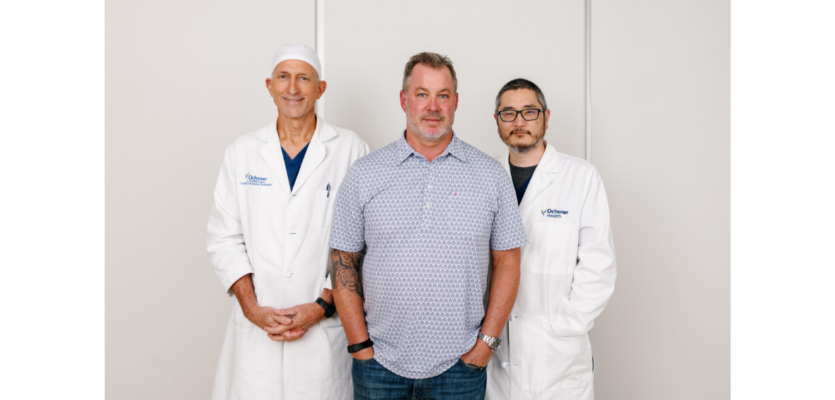
NEW ORLEANS - When Gregg Downing was recovering at home from a partial knee replacement, he expected his biggest challenge to be rehabilitation.
Instead, he soon found himself facing a life-threatening medical emergency.
One day shortly after his surgery, while talking on the phone with a friend, Gregg suddenly felt something was terribly wrong. The pain was severe and unlike anything he had experienced before.
"I texted my wife to come home immediately, which is something I never do," he recalled.
Recognizing the seriousness of his symptoms, he called 911 and was transported to Ochsner Medical Center – New Orleans, where emergency department physicians quickly determined he was experiencing a true emergency: an aortic dissection.
An aortic dissection occurs when a tear develops in the inner layer of the aorta, the body's largest artery. Blood can flow into the tear, separating the layers of the aortic wall and potentially disrupting blood flow to vital organs. Without immediate treatment, the condition can become fatal.
The hallmark symptom of an aortic dissection is sudden, severe chest or back pain that often reaches its peak within seconds. Gregg recalls feeling fine one moment before experiencing intense pain that immediately signaled something was wrong.
Much of Gregg's memory of arriving at the hospital remains a blur. What he does remember clearly are conversations with vascular surgeon, Dean Yamaguchi, MD and cardiothoracic surgeon, Gene Parrino, MD, who explained the severity of his condition and the need for immediate surgery.
"They both came in and explained what needed to happen and the order of the procedures," Gregg said.
According to Dr. Yamaguchi, dissections involving the ascending portion of the aorta almost always require emergency surgery because of the risk of stroke, heart damage and rupture. Every minute matters when treating these patients.
On March 11, 2026, Gregg underwent emergency surgery that lasted approximately seven and a half hours. The procedure required close coordination among multiple specialists and care teams working together to address the complex condition.
Recovery from aortic dissection surgery typically includes close monitoring, early mobilization and long-term follow-up. Gregg remembers being up and walking the day after surgery, an important milestone in his recovery journey. He spent one week in the hospital, including three days in the intensive care unit before transitioning to a regular patient room.
The physical recovery was challenging, but he says the support he received from both his care team and his loved ones made a tremendous difference.
"My wife was incredibly supportive," he said. "Even my neighbors would walk around the block with me because I couldn't walk alone."
Inside the hospital, he felt the same level of encouragement.
"The attentiveness of the staff was amazing," Gregg said. "My doctors and care team kept me informed every step of the way."
For Gregg, the experience was about more than surviving a medical emergency.
The unexpected health crisis came just months after the loss of his sister, prompting him to reflect on life, family and purpose. Recovery brought moments of uncertainty, but it also gave him a new perspective.
"Life is really short and can be taken away from you at any time," he said. "Each day is a gift."
Throughout his recovery, he drew strength from the reassurance provided by his physicians.
Gregg remembers one particular piece of advice from Dr. Yamaguchi that continues to stay with him today.
"He told me to put this behind me and recognize that I had a second chance at life," Gregg said.
Today, Gregg credits both the expertise of his surgical team and the support of those around him for helping him through one of the most difficult experiences of his life.
"Dr. Parrino and Dr. Yamaguchi, what they did was incredible," he said. "If there is a bright spot in what happened to me, it would be that I had an incredible experience in the hospital.”
For Gregg, the experience reinforced the importance of expert care, strong support systems and never taking a single day for granted.
"When people ask what saved me," he said, "I tell them: God, Dr. Yamaguchi and Dr. Parrino."
Watch Gregg’s full story: Life-Saving Heart Surgery Gives Gregg a Second Chance
To learn more about the Ochsner Heart & Vascular Institute, visit: https://www.ochsner.org/services/heart-vascular-services/
About Ochsner Health
Ochsner Health is the leading nonprofit healthcare provider in Louisiana, Mississippi and across the Gulf South, delivering expert care at its 47 hospitals and more than 370 health and urgent care centers. Ochsner is nationally recognized for inspiring healthier lives and stronger communities through expertise, quality and digital connectivity. In 2025, more than 40,000 dedicated team members and 5,000 employed and affiliated physicians at Ochsner cared for more than 1.6 million people from every state in the nation and 65 countries. To learn more about how Ochsner empowers people to get well and stay well, visit www.ochsner.org.